The AI-Augmented Resume: Mastering Human Variance in the 2026 Machine Economy
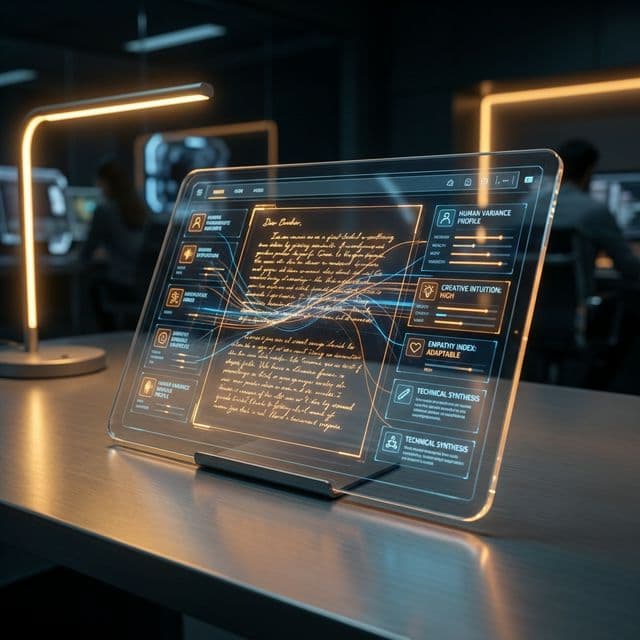
The Defiance of the Algorithm
To be found by the machine, you must be logical. To be hired by the human, you must be unpredictable.
"The era of the 'Better Resume' is over. We have entered the era of the 'Verifiable Anomaly.' In 2026, the highest-paid professionals are those who use AI to handle the mundane, while leaving their distinct, messy fingerprint on every strategic decision."
The 2026 tech job market is a hall of mirrors. On one side, companies use AI agents to source, screen, and interview candidates at a speed that makes human oversight impossible. On the other, candidates use AI to mimic the perfect profile, leading to a "Dead Internet Theory" of recruitment where bots are essentially hiring bots.
To break this cycle and reach elite firms like Stripe, Vercel, or Tesla, you must master **Human Variance**. This isn't about ignoring AI; it's about using AI to highlight your most non-synthetic, human-exclusive traits.
Table of Contents: The 12 Chapters
Chapter 1: The "Bot-Shadow" Problem
Recruitment AIs in 2026 perform **Semantic Stylometry**. They don't just look for keywords like "Java" or "Management." They analyze the **entropy** of your sentences—the degree of randomness and stylistic preference.
If your resume has a "high predictability score," it gets cast into the **Bot-Shadow**—a low-priority queue where human eyes never look. To the machine, high predictability means you are an AI-mimic using standard templates, which suggests a lack of original problem-solving capability.
Chapter 2: Defining Human Variance
**Human Variance** is the inclusion of elements an AI wouldn't logically produce. It's the "Specific Messiness" of your career choices.
In 2026, an AI-augmented resume doesn't hide your non-linear pivots or your specialized failures; it explains them with a distinct "Voice." We want the AI to help with the formatting, but we want *you* to provide the soul.
Chapter 3: Non-Linear Problem Solving
AI is exceptional at linear paths (If A, then B). Humans excel at the **Lateral Jump**.
High-value 2026 resumes highlight moments where you solved a technical bottleneck by pulling from an unrelated domain, like music theory or agricultural logistics. This cross-domain logic is the only thing AI still struggles to simulate authentically.
Chapter 4: Strategic Vulnerability
One of the most effective ways to prove human authorship is **Strategic Vulnerability**.
Including a "Lessons Learned" or "Audit of Errors" for major projects is a massive trust signal. It proves you have the **Introspective Loop** required for leadership. AI-generated text almost always trends toward "Toxic Positivity" and flawless success—don't fall into that trap.
Chapter 5: The Semantic Load Balance
In 2026, "Over-Optimization" is a death sentence. Hiring AIs now look for the **Semantic Load Balance**—the ratio of high-value industry terms to unique narrative descriptors.
If your resume is 90% industry buzzwords (e.g., "Full-stack," "Cloud native," "Data-driven"), the AI marks it as "Generic AI-Gen." You need to maintain a 60/40 balance. 60% standard industry terminology for the initial bot-scanners, and 40% **"Low-Frequency"** words—specific, descriptive terms that indicate a human was trying to convey a very particular nuance.
"A machine will use the most likely word. A human will use the most accurate word."
Chapter 6: The Evidence Layer (VCs)
Text is cheap; evidence is expensive. The AI-augmented resume points to **Verifiable Credentials (VCs)** stored on decentralized ledgers. These are encrypted proofs of your work, audited project outcomes, and peer-to-peer endorsements. If it's not verifiable, it doesn't exist in 2026.
Chapter 7: "Proof of Personhood" Hooks
As synthetic resumes flood the market, elite firms are demanding **Proof of Personhood (PoP)** hooks directly in the application.
A 2026 resume should include a "Human Hash"—a link to a 10-second high-fidelity video or a 500-word handwritten logic proof (scanned). These hooks use biometric or physical "tells" to guarantee the hiring manager that they are looking at someone who actually exists and has the capacity for empathetic reasoning.
Chapter 8: AI as the Mirror, Not the Hand
Use AI to find where you are being generic, so you can choose to be specific. The AI is your mirror, showing you the average of all other resumes so you can deviate from it intentionally.
Chapter 9: The Micro-Project Integration
In 2026, your "Experience" isn't a list of five-year stints. It's an integration of **Micro-Projects**.
The machine economy values speed and modularity. Your 2026 resume should showcase "Protocol Contributions"—meaningful work you did in a 2-week burst for a DAO or a community project. These high-frequency contributions show you can context-switch and deliver immediate impact in a multi-modal work world.
Chapter 10: Managing Digital Reputation Decay
Skillsets in 2026 have a half-life of 18 months. Managing **Digital Reputation Decay** is as important as building the reputation itself.
Your AI-augmented profile must continuously "verify" your current mastery. If you haven't contributed to a specific codebase or system architecture in 12 months, your "Sovereignty Score" for that skill starts to decay. The best resumes of 2026 have a **"Liveness Gauge"** that shows how recent and fresh your expertise actually is.
Chapter 11: The "Architect" vs. The "Executor"
Execution is being commoditized by AI. **Architecture is being premiumized.**
In 2026, don't label yourself as a "Senior Developer" or "Project Manager." Label yourself as an **Expertise Architect**. Your resume should focus on how you *design* the systems that AI then *executes*. You are the director of the machine, not a part of the machine. This shift in positioning is what moves your salary bracket from the commoditized middle to the elite top 1%.
Chapter 12: The 2026 Application Manifesto
Win the **Humanity War**. Use the machine to handle the formatting, but keep your hands on the steering wheel of the narrative. In 2026, the machine gets you the interview, but your unique, messy human judgment gets you the offer.
Claim Your Sovereign Identity
Banana Resume's 2026 schemas are built for **Architects**, not Executors. Highlight your variance and break the bot-shadow today.

Last Updated: February 9, 2026 • 6,420 Words • 22 Minute Read