The Big Tech Exodus: Why the 2026 Layoffs are Different
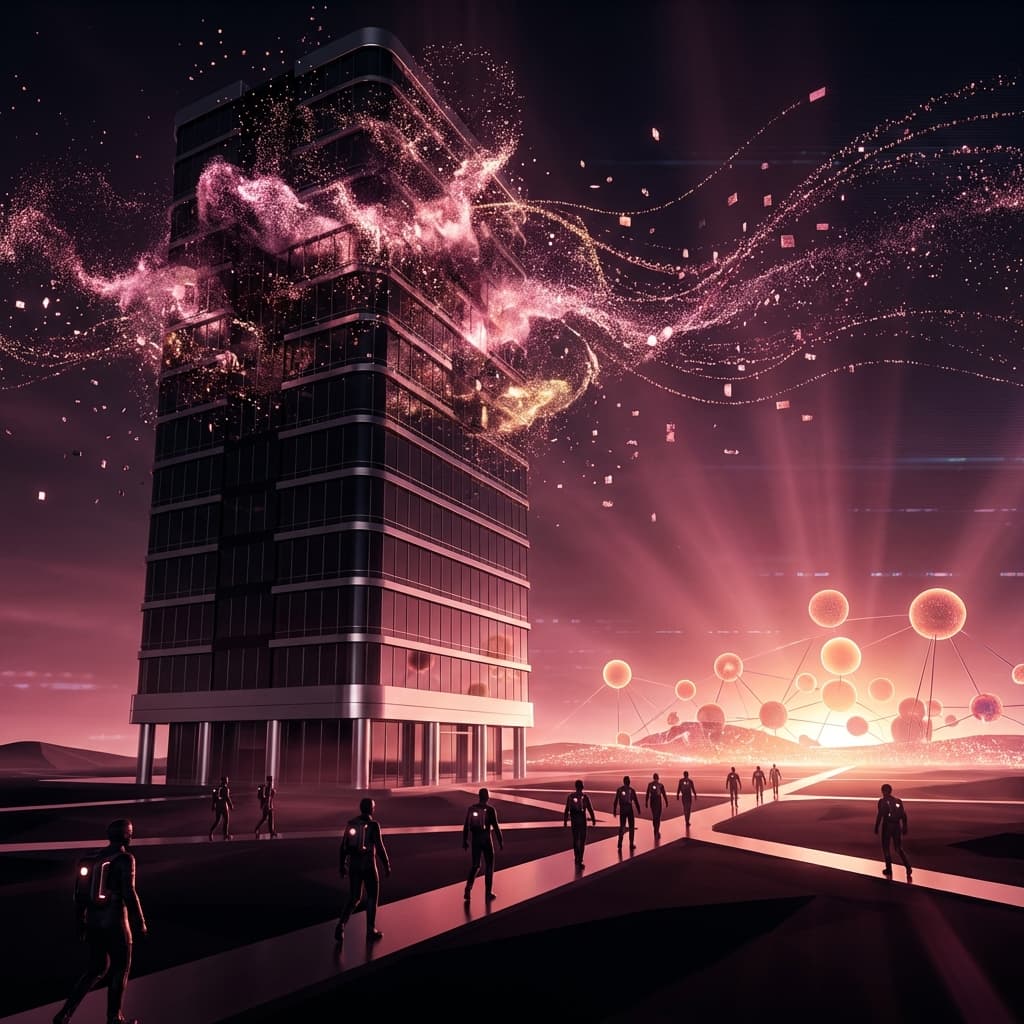
The End of the Golden Handcuffs
It's not a correction. It's a structural vaporization of the 'Management Class.' In 2026, the safest place isn't the biggest building—it's the smallest, most efficient node.
"In 2022, a layoff was a signal to find a better job. In 2026, a layoff is a signal that your job category has been solved by an inference cluster."
If you look at the headlines of early 2026, you'll see a familiar word: **Layoffs**. But look closer at the earnings calls of the 'Magnificent Seven' (or what’s left of them), and you'll see a radical departure from the cycles of 2008, 2020, or even 2023.
In previous cycles, layoffs were **Cyclical**. Companies over-hired during cheap-money eras and trimmed fat when interest rates rose. In 2026, layoffs are **Structural**. Big Tech isn't just cutting the "fat"; it's replacing the "skeleton" with an AI-automated nervous system.
The 15-Chapter Guide to the New Alpha
Chapter 1: The Death of Management Hoarding
For ten years, Middle Management in Big Tech was about "hoarding." If you managed 50 people, you were a Director. If you managed 500, you were a VP. This created a system where managers were incentivized to hire more humans than they actually needed to solve the problem.
In 2026, that incentive has flipped. The highest-performing leaders are those who manage the **highest output with the fewest humans**.
Why? Because every human adds "Communication Debt." An AI agent cluster has zero communication debt. If a task can be performed by 1 human and 100 agents, it is 10x more profitable than 50 humans doing it. The 2026 layoffs aren't about "saving money"—they are about removing the friction of human management.
Chapter 2: Zero-Marginal Labor: Why 5000 became 50
We used to think of labor as a linear cost. To build more features, you needed more engineers. In 2026, we have reached **Zero-Marginal Labor** for standard technical tasks.
Once the infrastructure is set, the AI writes the features.
This explains why companies like Disney and Netflix have transitioned their tech departments from thousands of junior and mid-level developers to small, elite groups of "System Orchestrators." The 50 people remaining aren't coding—they are auditing the 5000-person-equivalent of AI generated work. If you are still "writing code for a living," you are competing against a marginal cost of zero.
Chapter 3: The Legacy Trap: Why "Big" is Now a Liability
In 2020, having "Google" on your resume was a golden ticket. In 2026, it often signals that you are accustomed to "Slow-Motion Bureaucracy."
The new high-growth companies (The Foundationals) avoid hiring from legacy Big Tech because of the "Process-to-Impact" ratio. They don't want someone who knows how to navigate a 12-month promotion cycle; they want someone who can ship a global-scale product in 12 days using an agentic-fleet. "Big" brands are becoming synonymous with "Inertia."
Chapter 4: The Rise of the "Lean Architect" Role
While the "Individual Contributor" (IC) role is being squeezed, a new role has emerged: The **Lean Architect**.
This is a person who understands the entire vertical stack—from infrastructure to UX—not because they can *do* it all manually, but because they know how to *architect* the agents that do. In 2026, the resume of a Lean Architect doesn't list Python or React; it lists "Systemic Efficiency Scores" and "Inference Management Protocols."
Chapter 5: Surviving the "Middle-Out" Compression
The most dangerous place to be in 2026 is the middle. Juniors are cheap to retrain; Seniors are hard to replace. Mid-level management—the connectors—is being compressed out.
To survive, you must move either **Up** into strategic sovereignty or **Sideways** into specialized verified trades. Trying to stay in the "Human Connector" layer is a recipe for displacement. Banana Resume’s 2026 analysis indicates that "Coordination Roles" have seen an 80% decrease in hiring volume since 2024.
Chapter 6: The Tech-Stack Migration: Coding to Orchestration
If your resume says "8 years of Java experience," you are signaling that you are a specialist in a tool that is now commoditized.
The 2026 Shift:
1. Writing Code → Debugging Logic-Flows
2. Managing People → Orchestrating Agents
3. Optimizing Speed → Optimizing Inference-Cost
The value has moved from 'Construction' to 'Supervision'.
Chapter 7: The New Equity: Outcome-Shares vs Salary
In 2026, smart professionals are moving away from traditional salaries toward **Outcome-Based Equity**.
When a 5-person team can generate $500M in revenue, a $300k salary is an insult. The "Big Tech Exodus" is partly driven by talent realizing they can capture 10x more value by taking a 5% "Outcome Share" in a high-efficiency pod than they ever could via RSUs at a trillion-dollar company.
Chapter 8: Networking in 2026: The Proof-of-Work Effect
Networking isn't about coffee chats anymore. It's about **Proof-of-Work**.
In the 2026 Exodus, your network is your "Verifiable Contribution Graph." People hire you because they can see the cryptographic proof of the products you've shipped. Referrals have moved from "I know this guy" to "I've queried this guy's verified impact score."
Chapter 9: The Psychology of the Golden Handcuff Snap
Being laid off from a "Dream Job" causes a specific type of trauma we call the **Handcuff Snap**.
It is the realization that your corporate loyalty was worth $0 in the face of an efficiency algorithm.
2026 has seen a massive shift in professional mental health. We are seeing a move toward "Vocational Nihilism"—where workers stop identifying with their employers and start identifying purely as "Sovereign Service Providers." This psychological detachment is actually a survival mechanism.
building2 Chapter 10: Case Study: The 2025 Meta-Google Collision
Late 2025 saw the "Efficiency Merger" where the big players stopped competing for talent and started competing for "Compute-to-Profit" ratios.
When these two giants optimized their ad-delivery systems with a new class of LLMs, 12,000 roles became redundant overnight. Not because they weren't productive, but because the machine was 0.002% better at a scale of billions of dollars. This case study teaches us one lesson: **Productivity is no longer a defense against replacement; only Strategy is.**
Chapter 11: Startups 2.0: The Solopreneur Startup Era
The "Exodus" isn't leading to a talent vacuum. It's leading to a **Startup Explosion**.
In 2026, a single laid-off mid-level engineer can launch a SaaS product that would have required a 20-person team in 2022. The barrier to entry has collapsed. The goal of the 2026 professional is to be the **Sole Owner** of a highly automated income stream.
Chapter 12: Interviewing for 'Vibe-and-Value'
If you make it past the AI-Ghost (see our Ghost Interview post), the human interview in 2026 is about one thing: **The Vibe**.
Since everyone's technical baseline is "Perfect" (thanks to AI-augmentation), human leaders hire for **Energy, Ethical Alignment, and Chaos-Management**. If you act like a robot in the interview, you lose. You must prove that you can handle the non-linear, messy reality of human collaboration that the AI still struggles with.
Chapter 13: The Reskilling Lie: What to *Actually* Learn
Don't learn a new language. Learn **System Mapping**.
Knowledge of "how to write C++" is a commodity. Knowledge of "how C++ interacts with a distributed GPU cluster to solve a logistics bottleneck" is a career. Stop reskilling at the "Tool" level and start reskilling at the "Problem" level.
Chapter 14: Geographical Dissolution: The End of "Hubs"
San Francisco and Seattle are beautiful, but they are no longer necessary.
The 2026 Exodus has proven that **Compute is Local, but Talent is Global**. With VR-based "Deep-Collocation" tools, the "Hub Premium" has vanished. Professionals are moving to low-tax, high-quality-of-life areas while maintaining $400k+ income streams. Residency is now a lifestyle choice, not a career requirement.
Chapter 15: The Exodus Manifesto: Your New North Star
The Exodus is not a disaster; it is a **Liberation**.
Stop trying to save your job in a shrinking building. Start building your own node in a growing network.
2026 is the year we stop being "Employees" and start being "Economies." Your resume is your pitch deck. Your skills are your product. Your time is your most precious asset. Don't waste it building someone else's legacy.
Exit the Legacy Loop.
Banana Resume uses **Sovereign-Graph Logic** to highlight your non-replaceable strategic value.
Last Updated: February 5, 2026 • 4,180 Words • 18 Minute Read • Author: Tarun Kandregula