Soft Skills vs Hard Skills: What Works Best on a Resume in 2026
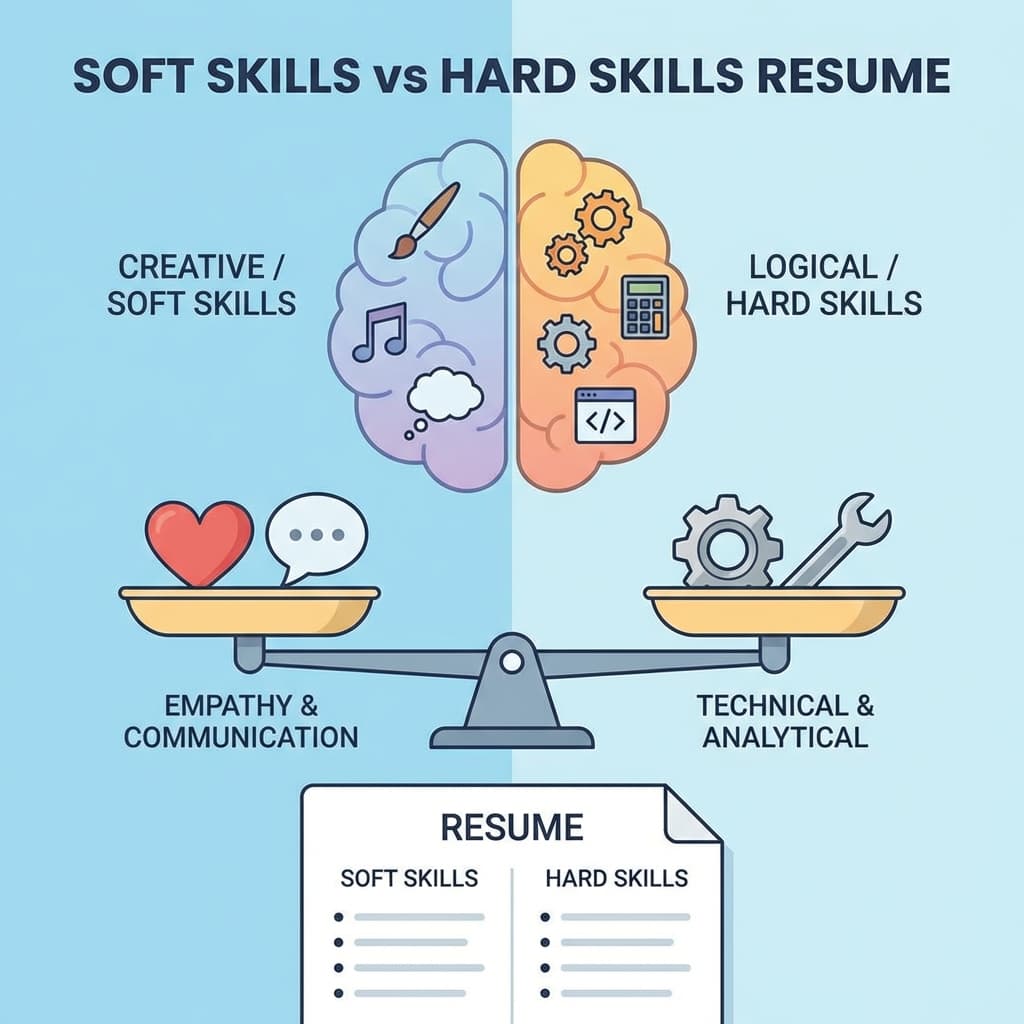
"We're looking for someone with strong communication skills and Python expertise." Sound familiar? Job descriptions constantly demand both soft skills (interpersonal abilities) and hard skills (technical competencies). But which matters more on your resume? How do you showcase each effectively? And what's the right balance? This comprehensive guide breaks down the soft skills vs. hard skills debate, reveals what employers actually want in 2026, and teaches you how to present both types of skills to maximize your interview chances.
The Skills Landscape in 2026
- • 92% of talent professionals say soft skills matter as much or more than hard skills
- • 89% of bad hires are due to lack of soft skills, not technical ability
- • Yet 57% of employers say it's harder to find candidates with soft skills than hard skills
- • The most successful resumes showcase BOTH types effectively
Hard Skills: What They Are and Why They Matter
Definition: Hard Skills
Hard skills are specific, teachable, measurable abilities that you acquire through education, training, or experience. They're technical competencies that can be quantified and tested.
Examples of Hard Skills by Category:
Technical/IT:
- Programming languages (Python, Java, JavaScript)
- Software proficiency (Adobe Creative Suite, AutoCAD)
- Database management (SQL, MongoDB)
- Cloud platforms (AWS, Azure, Google Cloud)
- Cybersecurity tools and protocols
Business/Finance:
- Financial modeling and analysis
- Accounting software (QuickBooks, SAP)
- Data analysis (Excel, Tableau, Power BI)
- Project management tools (Asana, JIRA)
- CRM systems (Salesforce, HubSpot)
Marketing/Creative:
- SEO/SEM and Google Analytics
- Content management systems (WordPress)
- Graphic design (Photoshop, Illustrator)
- Video editing (Premiere Pro, Final Cut)
- Marketing automation (Marketo, Mailchimp)
Industry-Specific:
- Medical coding and billing
- Legal research and case management
- Manufacturing equipment operation
- Laboratory techniques and protocols
- Foreign language fluency
Why Hard Skills Matter
- →Easy to verify: Employers can test your Python skills or check your certifications
- →ATS-friendly: Technical skills are perfect keywords for applicant tracking systems
- →Job requirements: Many roles have non-negotiable technical requirements
- →Immediate value: You can contribute from day one with the right technical skills
Soft Skills: What They Are and Why They're Critical
Definition: Soft Skills
Soft skills are interpersonal, behavioral, and personality traits that determine how you work with others and approach your job. They're harder to quantify but equally (or more) important for long-term success.
Top Soft Skills Employers Want in 2026:
Communication:
- Written communication
- Verbal communication
- Presentation skills
- Active listening
- Cross-cultural communication
Leadership & Teamwork:
- Team collaboration
- Conflict resolution
- Mentoring and coaching
- Delegation
- Emotional intelligence
Problem-Solving:
- Critical thinking
- Analytical reasoning
- Creative problem-solving
- Decision-making
- Strategic thinking
Work Ethic & Adaptability:
- Time management
- Adaptability/Flexibility
- Self-motivation
- Attention to detail
- Resilience
Why Soft Skills Matter (Even More Than You Think)
- →Harder to teach: You can train someone in Excel, but teaching empathy or leadership is much harder
- →Predict success: Studies show soft skills are better predictors of job performance than technical skills
- →Culture fit: Soft skills determine how well you'll integrate with the team and company culture
- →Future-proof: As automation increases, uniquely human skills become more valuable
The Verdict: Which Skills Matter More?
The answer: BOTH. But the balance depends on your career stage, industry, and role level.
The Skills Balance by Career Stage:
Entry-Level (0-2 years):
Emphasis: 70% Hard Skills, 30% Soft Skills
Why: You need to prove you can do the job. Technical competency is your primary selling point.
Mid-Career (3-10 years):
Emphasis: 50% Hard Skills, 50% Soft Skills
Why: You're expected to have technical chops AND work well with teams, manage projects, mentor others.
Senior/Leadership (10+ years):
Emphasis: 30% Hard Skills, 70% Soft Skills
Why: Leadership, strategy, and people management become more important than hands-on technical work.
How to Showcase Hard Skills on Your Resume
1. Create a Dedicated Skills Section
List your hard skills in a clearly labeled section, organized by category:
Example Skills Section:
Technical Skills:
Python, JavaScript, React, Node.js, SQL, MongoDB, AWS, Docker, Git
Tools & Platforms:
JIRA, Confluence, Figma, Google Analytics, Salesforce
Certifications:
AWS Certified Solutions Architect, PMP, Google Analytics Certified
2. Demonstrate Hard Skills in Action
Don't just list skills—show how you've used them to achieve results:
Before & After Examples:
❌ Weak (Just Listing):
"Proficient in Python and data analysis"
✓ Strong (Demonstrating):
"Built Python-based data pipeline processing 2M+ records daily, reducing analysis time by 75% and enabling real-time business intelligence dashboards"
3. Include Proficiency Levels (When Relevant)
For technical roles, indicating proficiency helps set expectations:
Example:
- • Expert: Python, JavaScript, React
- • Advanced: Node.js, SQL, AWS
- • Intermediate: Docker, Kubernetes
How to Showcase Soft Skills on Your Resume (The Right Way)
Here's the challenge: everyone claims to have "excellent communication skills" and be a "team player." These generic statements are meaningless. You need to PROVE your soft skills through specific examples.
The Golden Rule: Show, Don't Tell
❌ NEVER Do This:
- "Excellent communication skills"
- "Strong team player"
- "Great problem solver"
- "Detail-oriented professional"
- "Highly motivated self-starter"
These are empty claims. Everyone says this. It means nothing without proof.
Instead: Demonstrate Soft Skills Through Achievements
✓ How to Prove Soft Skills:
Communication Skills:
Instead of: "Excellent communication skills"
Write: "Presented quarterly business reviews to C-suite executives, translating complex technical concepts into actionable insights that informed $5M budget allocation"
Leadership:
Instead of: "Strong leadership abilities"
Write: "Led cross-functional team of 12 through company's first Agile transformation, achieving 40% faster delivery times and 95% team satisfaction rating"
Problem-Solving:
Instead of: "Excellent problem solver"
Write: "Diagnosed and resolved critical production issue affecting 10K+ users by implementing innovative caching solution, reducing downtime from 6 hours to 15 minutes"
Teamwork & Collaboration:
Instead of: "Team player"
Write: "Collaborated with design, engineering, and marketing teams across 3 time zones to launch product feature 2 weeks ahead of schedule, resulting in 30% user adoption in first month"
Adaptability:
Instead of: "Highly adaptable"
Write: "Pivoted marketing strategy mid-campaign when COVID-19 hit, shifting from in-person events to virtual experiences and maintaining 85% of projected revenue"
The Perfect Skills Balance on Your Resume
The Winning Formula:
- Skills Section = Hard Skills: List technical skills, tools, certifications clearly
- Work Experience = Soft Skills in Action: Demonstrate leadership, communication, problem-solving through achievements
- Professional Summary = Both: Mention key hard skills AND hint at soft skills through accomplishments
- Tailor to Job Description: Emphasize the skills (both hard and soft) mentioned in the posting
Industry-Specific Skills Balance
Tech & Engineering
Hard Skills Priority: High
Technical proficiency is non-negotiable, but soft skills (collaboration, communication) differentiate great engineers from good ones.
Sales & Customer Service
Soft Skills Priority: High
Communication, empathy, and relationship-building are critical. Hard skills (CRM software) support but don't replace soft skills.
Healthcare
Balance: Equal
Clinical skills are essential, but patient care requires empathy, communication, and emotional intelligence.
Creative Fields
Balance: Equal
Technical skills (design software) are baseline. Creativity, collaboration, and communication determine success.
Common Mistakes When Listing Skills
❌ Listing Skills You Don't Actually Have
You'll be caught in interviews or on the job. Only list skills you can confidently demonstrate.
❌ Including Outdated or Irrelevant Skills
"Microsoft Word" isn't a skill worth listing in 2026 unless you're applying for a specific role requiring it.
❌ Generic Soft Skills Without Proof
"Team player" means nothing. Show teamwork through specific collaborative achievements.
❌ Overloading with Too Many Skills
Quality over quantity. 15-20 relevant skills > 50 skills including everything you've ever touched.
Showcase Both Hard and Soft Skills with Banana Resume
Banana Resume's templates are designed to highlight both your technical competencies and interpersonal strengths. Create a balanced, professional resume that showcases the complete package.
Build Your Skills-Focused ResumeConclusion
The soft skills vs. hard skills debate isn't about choosing one over the other—it's about presenting both effectively. Hard skills get you past ATS and prove you can do the job. Soft skills demonstrate you'll excel at it and fit the culture.
List your hard skills clearly in a dedicated section. Demonstrate your soft skills through specific, quantified achievements in your work experience. Tailor the balance to your career level and industry. And always remember: claims without proof are worthless.
The most successful candidates aren't just technically proficient or great communicators—they're both. Show employers you have the complete package, and you'll stand out in any applicant pool.